

Read All About it — Hakone Ekiden 2026 in the Japanese Papers


With the ink barely dry on a record-breaking Hakone Ekiden 2026, I dove into the Japanese papers to see which stories were filling the column inches. Unsurprisingly, much of the shimbun real estate was devoted to Aoyama Gakuin's historic three-peat and the fifth-leg mountain heroics of ace runner Asahi Kuroda.
But away from the headlines, a different set of stories emerged. Stories of family members quietly supporting from the roadside, of a teammate’s name carried the full length of the course, of a team clawing its way into the top ten to secure a vital seeding spot, and of a generational talent already looking beyond Hakone. There were also the small details the papers love to linger on, right down to the single runner among 210 who chose to race in HOKAs.
Let's crack open the pages and see what we find.
Fresh-Green Dominance

As you might expect, every newspaper led with scenes from Aoyama Gakuin’s victory across days one and two. The coverage was full of deserved superlatives: records falling at both individual and team level, an unprecedented double three-peat, head coach Susumu Hara becoming the most successful in Hakone history, and the emergence of a new Yama no Kami. Quite a couple of days. But dig a little deeper and it becomes clear that the motivation driving this team ran beyond winning for winning’s sake.
A Seven-Star Performance for a Lost Friend
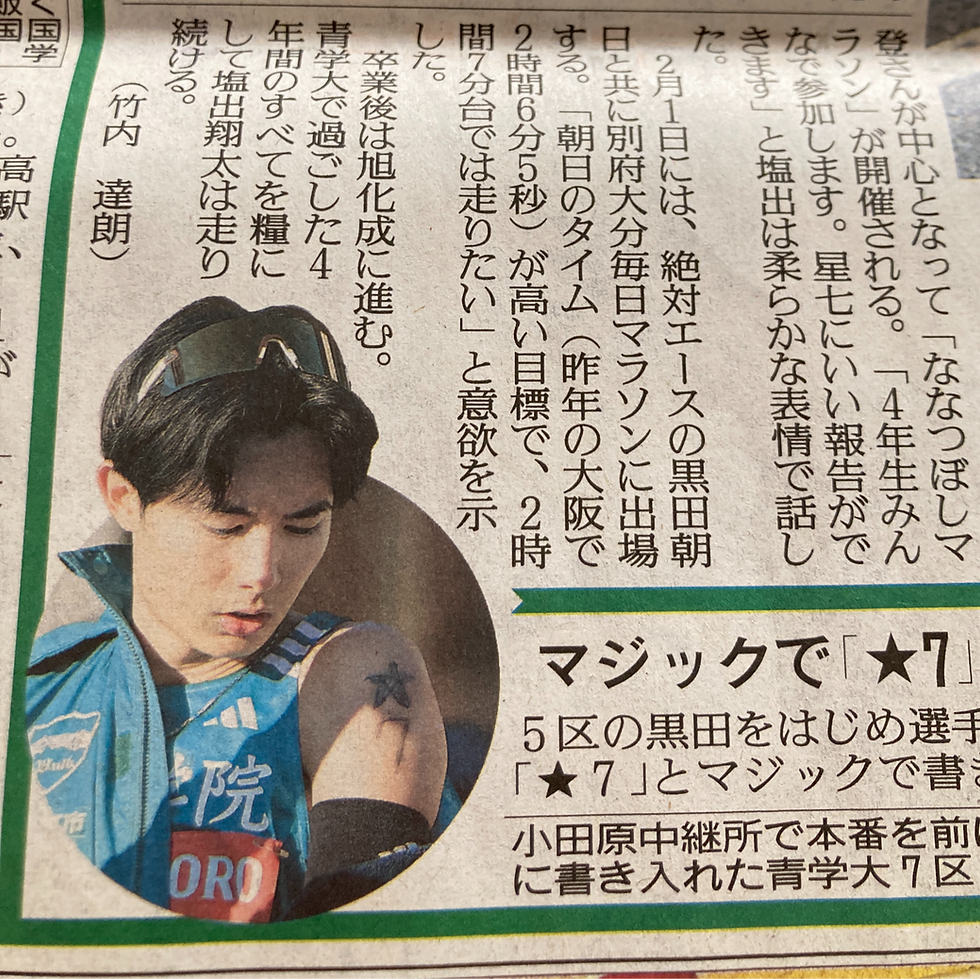
Across the papers, attention turned to the small ★7 drawn on Aoyama Gakuin runners and their fresh-green tasuki. The symbol was a tribute to their teammate Sena, whose name is written in kanji as 七星, “seven stars.” Sena passed away last year from malignant lymphoma. The team ensured his name was carried the full 271.1 kilometres, hand to hand, all the way from Otemachi to Hakone and back.
It Runs in the Family

One of the quieter stories amid the coverage of Asahi Kuroda's supercharged performance was his younger brother's role. Zen Kuroda, two years younger and also part of the Aoyama Gakuin Ekiden team, narrowly missed selection for the 16-man Hakone squad. Instead, he supported the team as the designated water attendant for the fifth leg, a role he took on at his brother's request. At the 15.8 km point on the mountain stage, Zen handed over the much-needed bottles as Asahi passed through. The article also notes that the Kuroda family is deeply rooted in running: both sisters compete at the national level, and their father ran the Hakone Ekiden for Hosei University in 2001.
Do You Believe in Miracles?

Hakone is not just about winning. For most teams without the depth to challenge the very top, the primary objective is securing a seeding position, automatic qualification for the following year’s race. That fight for a place in the top ten has, in many ways, become more ferocious than the battle for the podium itself.
Several papers devoted double-page spreads to Teikyo University, who produced one of the quiet miracles of this year’s Hakone Ekiden. After finishing 17th on day one, they began the return route more than four minutes outside the top ten. Leg by leg, the gap came down. By the ninth section it was just 13 seconds, and anchor runner Daiki Kamata completed the comeback, lifting Teikyo into ninth place at the finish. It marked the first time a team has recovered from 17th after the outbound leg to secure a seed: a result that reflected Teikyo’s self-styled reputation as “the world’s least willing team to give up.”
A 20-Year Seeding Streak Comes to an End
The focus on Teikyo’s late push into the seeding spots was balanced by significant coverage of Toyo University. The four-time champions finished 14th, bringing an end to a run of 20 consecutive years inside the top ten. There was no shortage of effort. One article noted that their anchor runner collapsed after crossing the line and was taken away on a stretcher. Still, missing a seed will have consequences for the school. The Ekiden world is unforgiving, and the weight of past success brings its own pressure.
Next Stop the States for Komazawa's Superstar

Sports Hochi focused on Keita Sato, Komazawa University’s standout star, whose four years at the school were repeatedly disrupted by injury. A Hakone Ekiden victory ultimately eluded him. Still, on day two he returned from a recent leg injury to deliver an anchor leg described by the paper as "operating on another level," breaking the 10th-section record. Sato brushed it off as the minimum standard he expects of himself. With graduation approaching in March, his sights are already set beyond Hakone. He plans to base himself in the United States, join an elite team, and focus on the track, with world and Olympic medals firmly in view.
Devilishly Detailed Runner Breakdowns

As we've seen, Japanese newspapers don't dabble when it comes to Hakone Ekiden coverage. They go all in. After each day, pages are given over to forensic breakdowns of every leg. The image above is taken from Sports Hochi after the first day. University names run down the side, followed by each runner listed left to right, complete with school year, high school, finishing time, position on that leg, and even the shoes on their feet. It's part results sheet, part scouting report. And yes, it's a lot. But for fans who live and breathe Hakone, this level of detail isn't excess. It's the point.
What's Behind all the Record-Breaking Performances?
Records fell across this year’s race, from individual leg times to overall day-one, day-two, and combined marks. Several newspapers paused to ask why. Their answers suggested that, as you can probably guess, it's to do with the advances in footwear and the training gains made possible by those shoes. But they also mentioned something else: the growing willingness among athletes and teams to train overseas alongside international peers. It makes you wonder if Japanese athletes can start to make a more significant statement on the international stage. Speaking of shoes....
These Shoes Were Made for Running (Hakone)

Shoe breakdowns are not just for funky graphics on Instagram. The newspapers are into it, too -- albeit in a much more basic way! The above graphic shows the shoe breakdown for the return leg on day two. From top left down: Mizuno, On Puma, Nike. From top right down: New Balance, HOKA, adidas, ASICS.
The text at the top explains the shoe breakdown over two days: Adidas was the most worn brand, with 47 runners. As in the previous edition, the company ranked joint first on both the outbound and return routes, completing a “perfect sweep.” Across both days of the race, 75 runners competed in Adidas shoes. Of the 210 athletes who started, 35.7% (75 runners) wore the brand. Popular models included the Adizero Adios Pro EVO 1, priced at 82,500 yen, along with other shoes from the EVO series. Second was ASICS with 28.5% (60 runners), followed by Nike at 16.6% (35 runners) and Puma at 14.7% (31 runners). New Balance was worn by three runners, On by three, Mizuno by two, and HOKA ONE ONE by one.
(Who was that one HOKA runner you ask? Well, as we have such detailed breakdowns, we can easily find out. The runner was Tokyo Kokusai University's Takuma Nakayama, running the 6th leg in the Cielo X 1 2.0's.)
Optical Exhaustion
Working through pages of Japanese newspapers is demanding on the eyes. Every sliver of space is filled, whether with dense blocks of text or highly stylised, colourful type. Another familiar quirk is the use of childlike illustrations, used to flag placings, time gaps, and small pieces of trivia. By the time you reach the end, it can feel as though you’ve run to Hakone and back.
Until next time!


Comments